Scaling GenAI Beyond the Prototype. Why MCP and A2A Matter.
The AI ecosystem is rapidly evolving to support agentic workflows, where multiple specialized AI models (agents) must work together and draw on external data. Two new open standards address complementary parts of this puzzle. Anthropic’s Model Context Protocol (MCP) standardizes how AI models access external tools and data, giving them richer “context” for their tasks. Google’s Agent to Agent (A2A) protocol standardizes how independent AI agents communicate and coordinate with each other. In short, MCP is about vertical integration (model ↔ data, tool and prompt templates), while A2A is about horizontal collaboration (agent ↔ agent). The two are designed to complement one another (as Google notes, A2A “complements” MCP), but there are already hints of overlap and strong incentives for future convergence as both protocols evolve.
Model Context Protocol (MCP): Giving AI Models More Context
MCP is an open standard for connecting AI models (especially LLM based agents) to external data sources and tools. Its goal is to eliminate the custom “glue code” traditionally needed when an AI needs information from company databases, APIs, document repositories, or other systems. Instead of inventing a new integration for each data source, MCP provides a universal two way interface: developers build MCP Servers that expose data or capabilities, and MCP Clients (the AI apps or agents) connect to those servers in a standardized way. In other words, MCP works like a standardized adapter that lets AI systems connect to tools and data sources without writing custom glue code each time: it lets models safely pull in external content and invoke tools via a consistent protocol.
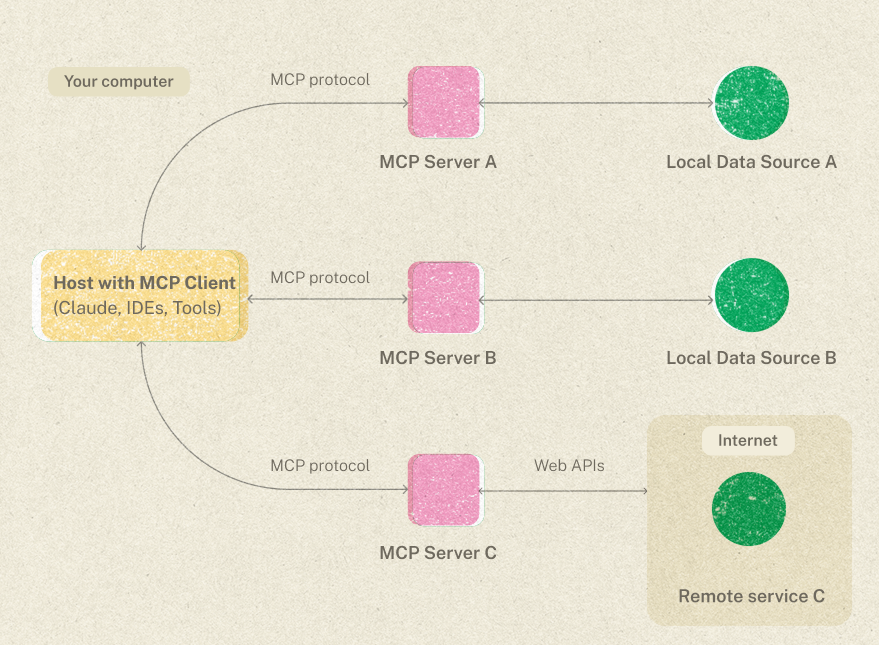
- Purpose: Provide LLMs with real time, structured context from outside their training data. For example, an AI coding assistant can use MCP to pull in the contents of a GitHub repo or query a database schema on the fly.
- How it works: MCP uses a client server architecture over standard web transports. An MCP Server might wrap a database, a document store, or any API and present it to AI as a set of functions or data streams. The AI agent (an MCP Client) sends JSON requests (over STDIO, SSE, etc.) to call these functions or fetch data, and the server responds with structured results. This replaces a tangle of one off integrations with a single protocol.
- Key features: MCP defines capability descriptors (what tools or data an agent can use), function calls (AI invokes a tool by name), and context blocks (embedding fetched data into the prompt). It supports chaining calls (the AI can run a loop of actions) in a standardized way. Importantly, the protocol is model agnostic, any LLM or AI system can use MCP servers once the interface is defined.
- Benefits: Because MCP is open and standardized, different tools (e.g. email, calendars, web APIs) and LLMs (ChatGPT, Claude, etc.) all speak the same “language” for context. AI developers can build against MCP instead of writing bespoke connectors for every data source. MCP makes AI systems context aware in a plug and play fashion, analogous to how REST APIs gave programs a common way to talk to web services.
Agent to Agent (A2A) Protocol: Enabling AI Agents to Talk
While MCP connects models to data and tools, the A2A protocol connects models to models. Google’s Agent to Agent Protocol (A2A) is an open standard that provides a common language for AI agents to communicate and collaborate. Each AI agent is essentially an autonomous LLM application that exposes a web accessible interface. That makes it possible for agents to interact as if they’re services on the web. A2A defines how agents discover each other and exchange messages so that, for example, one agent can delegate a task to another, or agents can jointly solve a complex problem. The designers compare A2A to HTTP for humans – a universal way for any agent to talk to any other without custom glue code.

- Purpose: Let multiple AI agents (possibly made by different teams or companies) interoperate in multi-agent systems. For instance, an HR agent might need to consult a payroll agent, or a personal assistant agent might call on a travel booking agent. A2A provides the protocol for these agents to securely initiate tasks, pass responses, and coordinate workflows.
- How it works: A2A is built on web standards (HTTP and JSON) but defines its own message formats. Each agent publishes an Agent Card (a JSON document) listing its identity, capabilities (what tasks it can perform), endpoints, and authentication info. Other agents can fetch these cards to discover and connect. Communication is done via tasks: an agent acting as client sends a request over JSON RPC (or similar) to another agent’s A2A server endpoint. The message can include text, structured data, or even file links. The server (another agent) processes the task (perhaps running an LLM or external tool) and returns artifacts (results) or streaming updates.
- Key features: A2A specifies message parts (e.g. text parts, JSON data parts, file parts) and conversation threading so that multi turn dialogues between agents are coherent. It also defines error handling and status updates (agents can poll or use server sent events to track long running jobs). Crucially, agents remain opaque to each other: one agent doesn’t need to see the internal LLM prompt or memory of another, only the structured messages passed over the protocol.
Complementary Roles
In practice, MCP and A2A are complementary pieces of the agentic AI puzzle. MCP acts like the “toolbus” for an individual agent – it lets the agent plug into external data and APIs as needed (adding context). A2A, by contrast, is the “social network” for agents – it gives them a shared language and protocol to find each other and work together.
- Access vs. Collaboration: MCP provides agents with access to data and functionality. For example, an AI sales assistant might use MCP to query realtime inventory or customer records. A2A provides agents with access to each other, e.g. that sales assistant could hand off a complex accounting task to a finance agent. The A2A documentation puts it succinctly: “MCP connects agents to tools… A2A facilitates dynamic, multimodal communication between different agents as peers”. In other words, MCP is about vertical tool integration, while A2A is about horizontal agent communication.
- Saved development time: By combining the two, developers get a clean two tier integration. A2A handles communication between agents, while MCP connects agents to their tools.” This means each concern has its own standard: no need for custom bridging code when one agent needs tool data (just use MCP) or when agents talk to each other (use A2A).
- Official stance: Google explicitly positions A2A as complementary to MCP. In its announcement, Google notes that “A2A is an open protocol that complements Anthropic’s MCP, which provides helpful tools and context to agents”, current best practice is to use MCP for tool access and A2A for agent orchestration.
Overlap
Despite this clear division, there is a bit of conceptual overlap, which can lead to confusion in design. Both protocols involve sending structured JSON messages and managing task flows, so in some scenarios they could be used to solve similar problems. For example, one could technically wrap an external service as either an MCP server or an A2A agent. If you deploy a “weather agent” that answers queries about the weather, you could call it via A2A or simply expose a weather API via MCP. Both approaches get data to your main agent, but via different paths. So the overlap is minimal today, but not zero.
Looking ahead, it’s likely that the boundaries will blur as both protocols evolve. Here are some ways this convergence could happen:
- A2A with richer context: Today, A2A messages mostly carry task descriptions and results. But as agents take on more complex jobs, A2A may start to incorporate semantically rich context directly. For example, future A2A revisions might allow agents to attach knowledge graph snippets or memory state to their messages, effectively adding a layer of context sharing that looks similar to what MCP does.
- MCP with multi agent flows: Conversely, MCP could expand beyond single agent context to support basic agent coordination. For instance, an “MCP orchestrator” could expose composite capabilities that internally involve several models. Imagine a complex MCP tool that actually invokes two different AI agents under the hood to fulfill a query, essentially a rudimentary multi agent workflow managed via MCP. Or MCP messages could embed instructions to notify or involve other agents. Such features would blur into the territory of multi agent negotiation. In practice, developers might build agent conductor services on top of MCP servers that assign tasks to multiple LLMs and aggregate results. Over time, those conductor patterns might be folded into MCP’s standard, making MCP itself more agent like.